Insurance POD: AI for underwriting, claims and reinsurance
A principal-led team of insurance, data and AI engineers that takes one process on one line of business — submission to bind, FNOL to close, or ceded reinsurance — from email and spreadsheets to a governed workflow in production, inside your environment. Agents prepare; your people decide inside their authority.
For carriers, MGAs and reinsurance teams
Underwriting teams
Broker submissions rekeyed from email, ACORD forms and loss runs, clearance done by hand, and renewals that start too late.
Claims leaders
First notice to close spread across email, spreadsheets and memory, with reserves that move late and recoveries nobody chases.
Ceded reinsurance teams
Cessions, bordereaux, notices and cash calls assembled in spreadsheets at quarter end, with net figures that disagree between systems.
Signs it is time
- Submissions are rekeyed from email and ACORD forms
- Underwriters spend their day on clearance
- Reserves are set late or stair-stepped
- Ceded recoveries are chased at quarter end
- Bordereaux live in spreadsheets
- AI pilots cannot show who approved what
What is true at the end of the POD
For one process on one line of business. Most carriers add the next line once the first is proven in production.
One process live for one line
Submission to bind, FNOL to close, or a ceded process running on real volume with your people in the loop.
Documents read into data, with citations
ACORD forms, SOVs, loss runs and wordings extracted with confidence scores and a link to the source page.
Agents that work inside authority
Agents read, check and draft; decisions above a limit go to the right person, and nothing binds or pays without them.
A round trip with your core systems
Data out of policy admin and claims, decisions and documents back in, so there is no second system of record.
Controls that are enforced and traceable
Certified prompts, traces of every agent run, and a decision record a regulator can follow a year later.
A data foundation for the next line
Conformed policy, claim and premium data on the P&C lakehouse blueprint, ready for the second line of business.
What the team delivers, week by week
Shown for a 12-week POD; a line with more document variety or integrations runs to 14.
Discovery
- Choose the process and the line of business
- Map today's flow, systems, document mix and authority levels
- Baseline cycle time and touches per item
- Outcome statement and scope
- Current-state map and baseline
- A fixed proposal naming the POD team
Foundation
- Stand up the workbench in your environment
- Wire the policy admin and claims integrations
- Configure extraction for the line's documents; first real items end to end
- Target design signed off by underwriting or claims
- Integrations in test
- First items flowing end to end
Build & iterate
- Configure rules, rating, authority and referrals
- Tune extraction and agents on live volume
- Measure accuracy and straight-through rates every two weeks
- Weekly demos with underwriters or adjusters
- Accuracy and cycle-time reports
- Controls tested against the checklist
Production & handover
- Go live for the line with a first team
- Model and agent monitoring; audit trail review
- Paired delivery until your team owns it
- Runbooks and decision records
- Monitoring dashboards
- Plan for the next line of business
Every week: a demo of working software against the outcome metric. Every two weeks: a steering review. No status decks.
One evidence trail from submission to cession
The Insurance Suite in a carrier's environment: documents and core systems on the left, the workbenches in the middle, and the people and parties they serve on the right.
Inputs
Insurance Suite
People & parties
- InsightPrompts certified prompts
- InsightLense traces
- Authority and referral rules
- Transactional outbox to reinsurance
- PII handling
- P&C lakehouse blueprint
Agents act like people do
Agents use the same APIs and the same authority limits as the people they help. The AI-first stack.
Reinsurance hears every event
Bound policies and claim payments reach reinsurance through an outbox, in the same transaction. The outbox pattern.
Controls you can test
Authority, money and derived figures are enforced, not only displayed. The controls checklist.
What Insurance PODs are asked to do
Submission to bind
Broker email to a bound policy, with clearance and referrals. Walkthrough.
FNOL to resolution
Coverage, reserve and settlement prepared inside authority. Walkthrough.
Renewal review
A 180-day scan that reads the risk, not only the premium. Worked example.
Ceded reinsurance
Cessions, notices, cash calls and bordereaux without lost events. The pattern.
Broker submissions
Complete submissions and renewal packs for brokers. Insurance brokers.
Insurance data platform
The governed lakehouse underneath. The blueprint.
The Insurance Suite the POD configures
Every Insurance POD starts from these products, configured to your lines and systems rather than written from scratch.
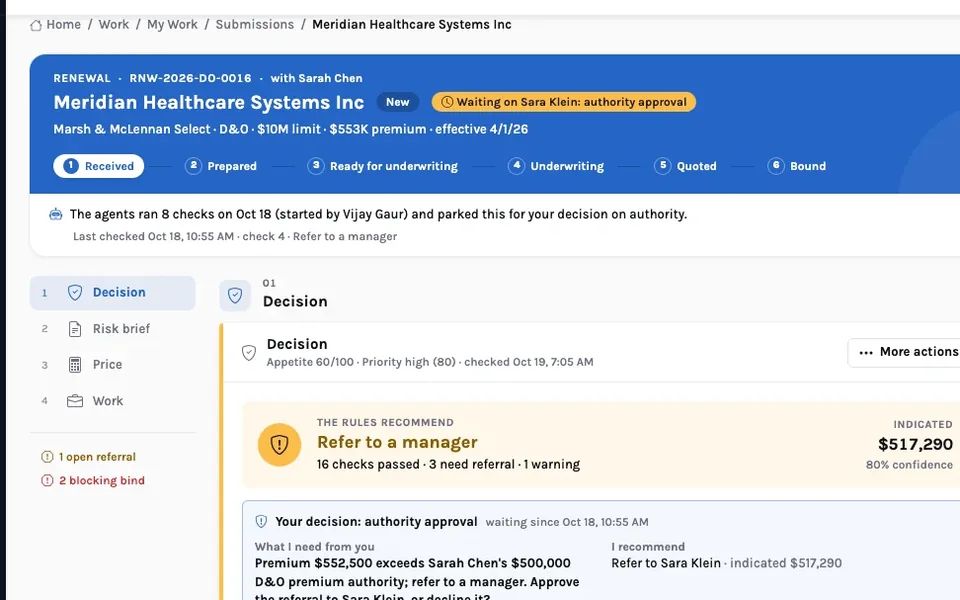
InsightUW
The agentic underwriting workbench for P&C: agents read, check and draft, and underwriters decide inside their authority.
- Reads broker emails, ACORD forms and loss runs into one submission
- Appetite, clearance and authority checks, then the decision parks for the underwriter
- Rating, quote, bind and renewal across 16 lines of business
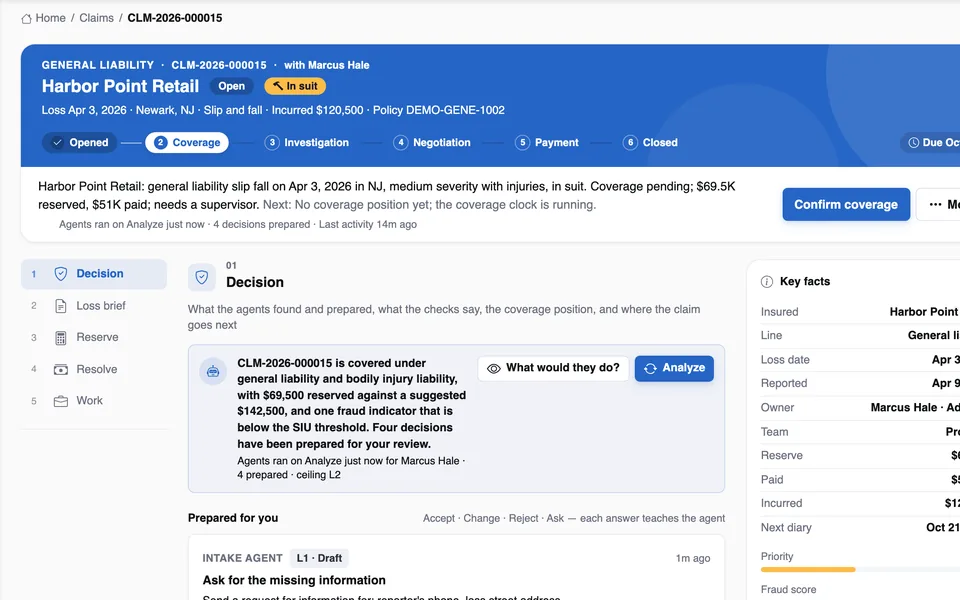
InsightCW
The agentic claims workbench for specialty P&C, from first notice to close.
- Ten claims agents prepare; the adjuster decides
- Coverage position, reserve, letters and approval brief, each cited to the record
- Litigation, recoveries, SIU and catastrophe desks on the same record
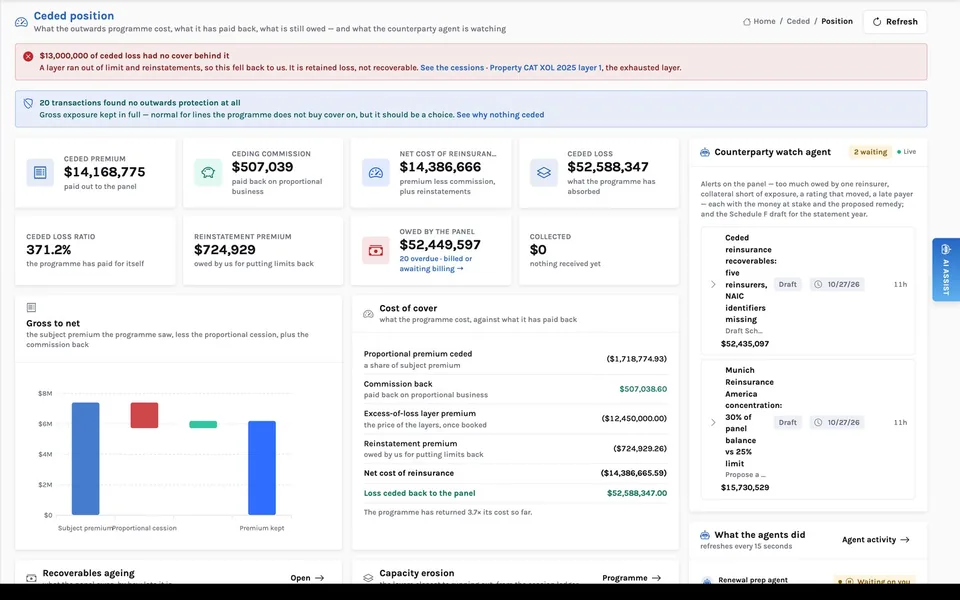
InsightCede
The agent-driven ceded reinsurance workbench: agents prepare, people decide.
- A deterministic engine computes every cession
- Notices, cash calls, reinstatements, bordereaux and Schedule F prepared by governed agents
- Ceded position, erosion and credit in one view
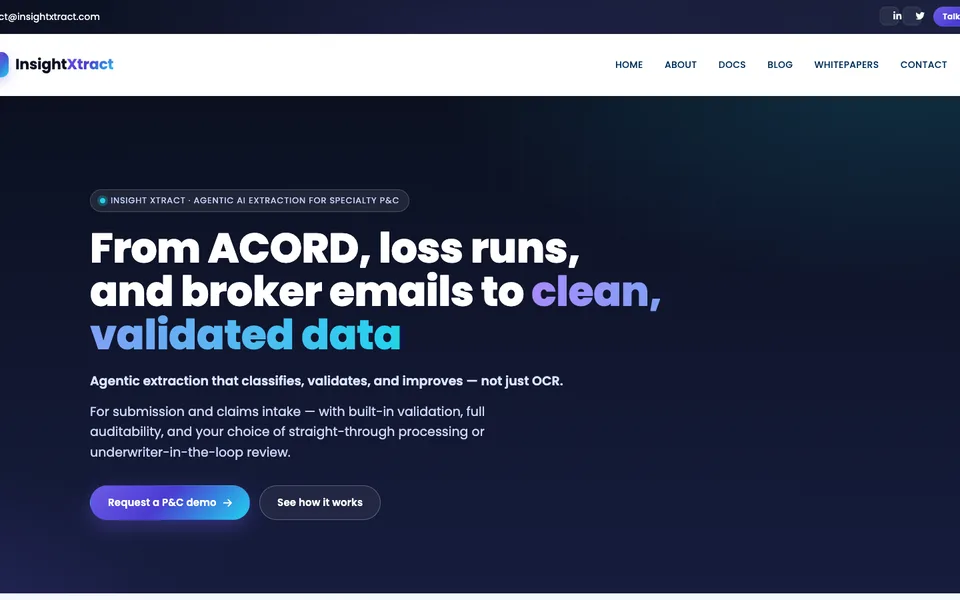
InsightXtract
Agentic information pipelines for document processing and data extraction, built for P&C submission variability.
- Classification, confidence and conflict resolution
- Clickable citations back to the source page
- ACORD forms, SOVs, loss runs and policy wordings
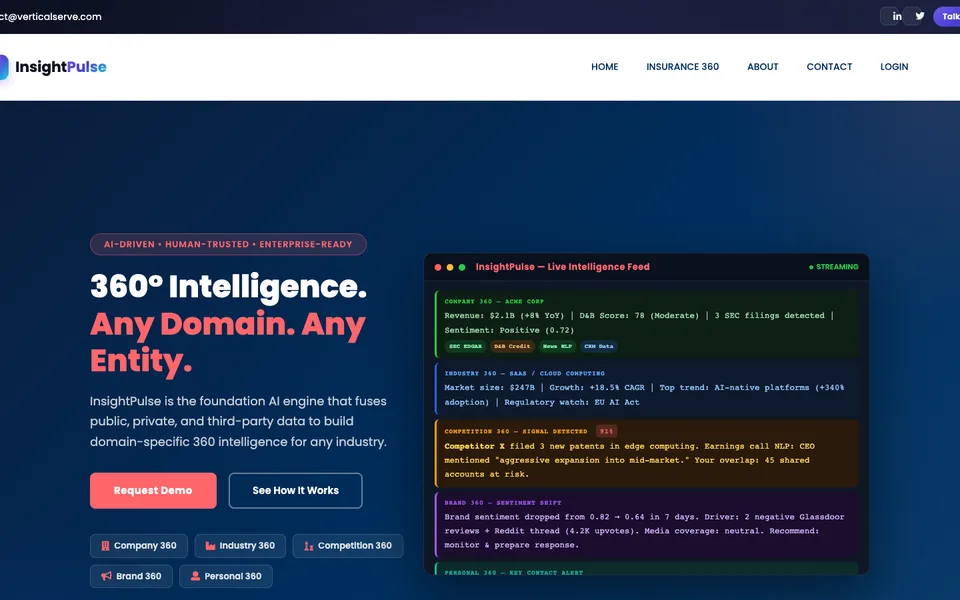
InsightPulse
Company, industry, brand and people intelligence, with every signal cited to its source.
- Insurance 360 entity views for insureds and brokers
- Signals such as litigation, M&A or a leadership change before a renewal
- One API and a research workspace; feeds InsightUW triage
From the insurance practice
How the suite fits together and the patterns the Insurance POD builds on. More on the insurance industry page.
Architecture, patterns and worked examples
- Insurance · AIThe AI-first P&C insurance stackSubmission to FNOL to analytics on one platform: agents prepare, people decide.
- Insurance · GuideAI controls in insurance operations: a practical checklistNewAuthority, money, derived figures, traceability, evaluation and people, and how to test each.
- Reinsurance · PatternCeded reinsurance without lost events: the transactional outboxNewWhy every bound policy and claim payment should reach reinsurance through an outbox.
- Underwriting · Worked exampleA renewal review that reads the risk, not only the premiumNewA 180-day scan, severity-weighted flags, referrals and rate versus exposure.
- Insurance dataBuilding a modern lakehouse for P&C insuranceNine schemas, a conformed star schema and the decisions that keep premium and loss honest.
- Brokers · AIThe AI-first broker suiteSix workbenches from placement and policy checking to claims advocacy.
Questions about the Insurance POD
Which lines of business do you support?
Personal lines (home, auto, renter, health), commercial P&C including D&O, E&O and cyber, and specialty lines such as environmental, medical, excess and surplus, and reinsurance. Templates, questionnaires and extraction schemas are configured per line.
Do we have to replace our policy admin or claims system?
No. The POD integrates with the systems you have: data comes out of policy admin, claims, billing and rating, and decisions and documents go back in, so they stay the system of record.
Who makes the decisions?
Your people. Agents read, check and draft; anything above an authority limit is referred, and nothing is bound, reserved above limit or paid without a person approving it. Every decision is recorded with the rule and the facts behind it.
How long does a line of business take?
Typically 10 to 14 weeks for the first process on the first line, depending on document variety and integrations. Further lines go faster because the integrations and data foundation already exist.
Where does our data go?
Nowhere outside your environment. The suite and the POD work inside your cloud accounts, behind your IAM, with PII handled according to your policies.
How do you handle AI regulation?
Controls are designed in from the first week: authority, money, derived figures, traceability, evaluation and people. The checklist and the regulatory context are in AI controls in insurance operations.
Scope an Insurance POD
Tell us which process and line of business hurts most and what blocks straight-through processing today. We will come back with an architecture opinion and a sequenced plan.
We reply within one business day
A principal reads your note and comes back with questions, not a brochure.
A 30-minute scoping call
The outcome, the systems involved, the constraints, and who on your side will own the result.
A one-week discovery
It ends with an outcome statement, a scope and a fixed proposal naming the POD team.
Prefer email? contact@verticalserve.com. VerticalServe works from Millburn, New Jersey and Pune, India.