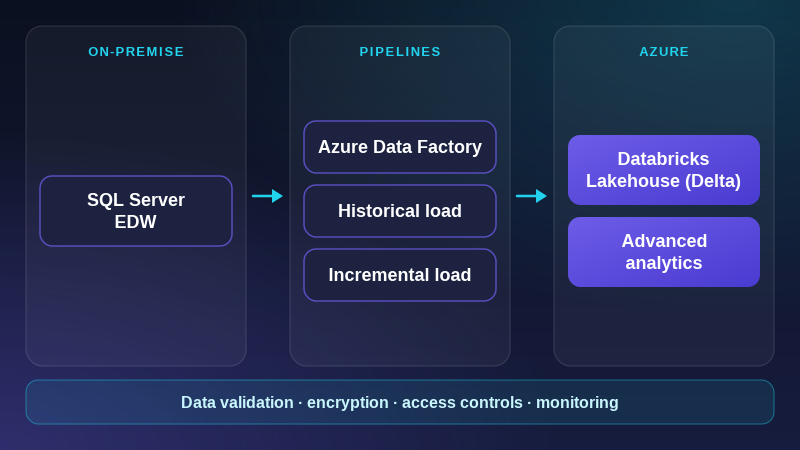
SQL Server EDW to a Databricks Lakehouse on Azure for a financial firm
OutcomeThe warehouse now runs on a Databricks Lakehouse: faster queries, pay-as-you-go cost and regulatory controls built in.
A small, senior team of Databricks engineers working inside your cloud. Unity Catalog governance from the first table, medallion pipelines with quality checks, Databricks SQL serving and MLflow, delivered as one agreed outcome — usually a first domain in production — in about 12 weeks.
Teradata, Netezza, Oracle, SQL Server or Cloudera estates moving to Databricks with converted code, parallel runs and reconciliation before cutover.
Tables still in the Hive metastore, workspaces created by hand, unclear ownership and spend nobody can attribute.
Governed tables, features and vector indexes that agents and models can use with the same permissions as SQL.
Workspace topology, catalog and schema layout, environments and access model, written down with the reasons.
Bronze, silver and gold layers for one domain, with expectations, quarantine paths and reconciliation against the source.
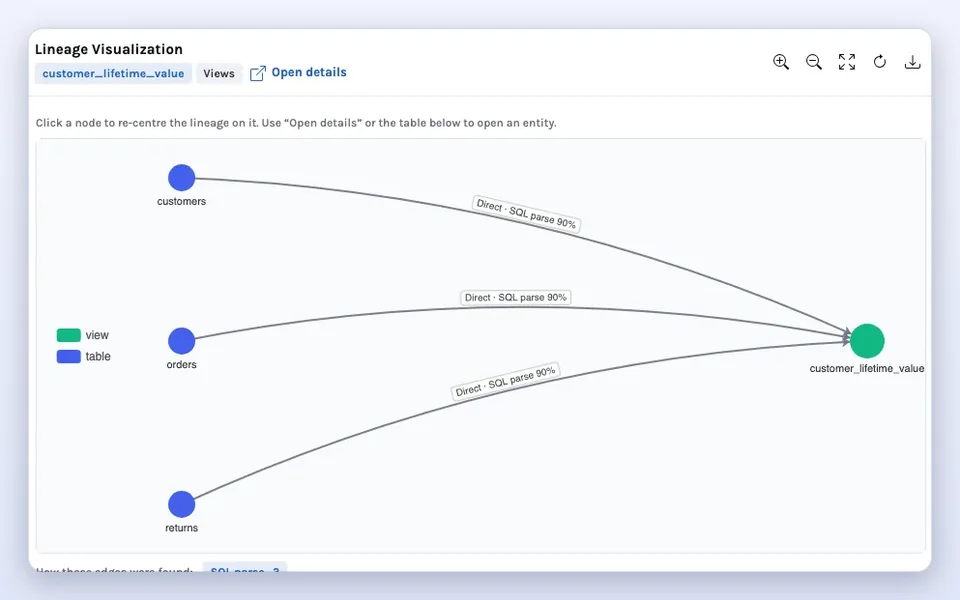
Unity Catalog groups, row filters, column masks, tags and lineage, so analysts and agents get the same enforced permissions.
A serving layer on Databricks SQL that BI tools and apps read, sized and clustered for the real queries.
Terraform and Databricks Asset Bundles, CI/CD for pipelines, cluster policies and cost attributed through system tables.
MLflow tracking and registry, model serving or Vector Search where they are in scope, on the same governed tables.
Every week: a demo of working software against the outcome metric. Every two weeks: a steering review. No status decks.
The layers a Databricks POD builds for the first domain, and the controls that apply to every one of them.
Unity Catalog is set up before the first pipeline, so nothing has to be retrofitted. Reference architecture.
Old and new run side by side and are reconciled at row and measure level. Migrating safely.
Agents read the same governed tables as people. The serving layer.
SQL Server, Teradata, Netezza or Oracle onto Databricks. A case study on Azure.
Hive metastore to Unity Catalog without breaking production. Field guide.
A deployable P&C blueprint across nine schemas. The blueprint.
Kafka and Flink into Delta or Iceberg in near real time. Read more.
Features, vector indexes and governed serving for agents. Read more.
Cluster policies, serverless choices and chargeback by tag. FinOps.
Our own InsightLake products, deployed in your environment where they shorten the path. You are not required to keep them.
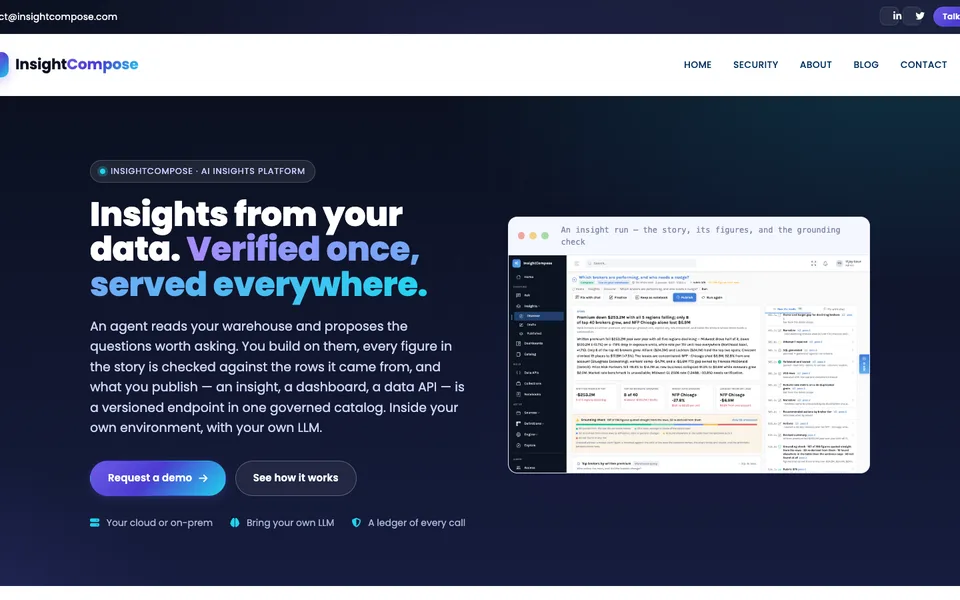
Discover insights in your warehouse, verify them once and serve them everywhere: answers, dashboards and data APIs.
Enterprise AI data catalog for metadata search across databases, streams, workflows and BI.
Low-code and no-code workflow engine for agents, data, ML and AI pipelines across clouds.
Case studies from our data platform engagements, and the Databricks guides the POD works from. More on the Databricks consulting page.
Not every engagement below ran on Databricks; each is the same team and the same method on a data platform.
OutcomeThe warehouse now runs on a Databricks Lakehouse: faster queries, pay-as-you-go cost and regulatory controls built in.
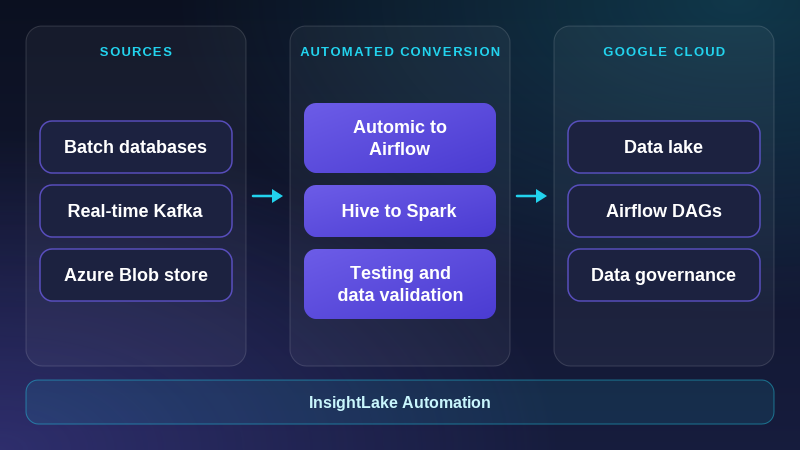
OutcomeOn-premise Hadoop replaced by a data lake on Google Cloud, with workflows converted to Airflow DAGs by automation.
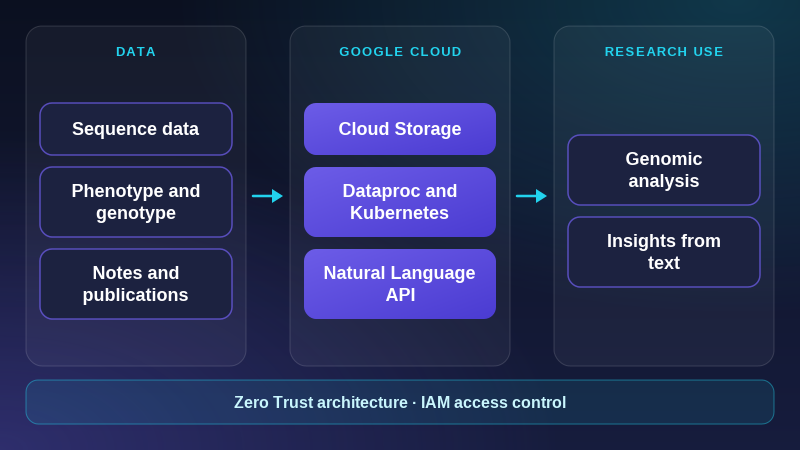
OutcomeOne platform for genomic data, bioinformatics pipelines and NLP on clinical text, secured with Zero Trust access.
Databricks on AWS, Azure or Google Cloud, in your account. The workspace topology, networking and identity design follow your cloud's landing zone.
Often more so. The POD starts with a lakehouse health check — schema drift, clustering versus real query patterns, orphaned tables, missing comments and spend hot spots — and the first outcome is frequently a Unity Catalog migration or a governed rebuild of one domain.
With conversion tooling for SQL, stored procedures and scheduler definitions, then old and new run in parallel and are reconciled at row and measure level. Cutover is a decision backed by those reports.
Decided per workload, on cost, start-up time and network requirements. Cluster policies and system tables make the choice visible and keep it enforced.
The data stays in open formats (Delta, and Iceberg where needed) in your storage, the code is yours, and the platform is described in Terraform and Asset Bundles you own.
Yes, where it is in scope: MLflow, model serving and Vector Search on the same governed tables. For copilots and agent platforms, the GenAI POD joins the team.
Tell us what you are moving from, the first domain that matters, and what the business keeps asking for. We will come back with how we would approach it.
A principal reads your note and comes back with questions, not a brochure.
The outcome, the systems involved, the constraints, and who on your side will own the result.
It ends with an outcome statement, a scope and a fixed proposal naming the POD team.
Prefer email? contact@verticalserve.com. VerticalServe works from Millburn, New Jersey and Pune, India.