- contact@verticalserve.com
Industries · Rental, Mobility & Storage
Data & AI for rental, mobility & storage
Every rental business runs on the same three questions: what do we have, where is it, and what should it cost today. We build AI-native 360s that answer them from one governed data model — for car rental fleets and self-storage portfolios.
The rental domain we work in every day
FleetUtilizationPricing & rate plansReservationsStations & airportsDamage & claimsTolls & finesLoyaltyCorporate accountsUnit mixStreet ratesRent increases (ECRI)Occupancy
The problems
What slows rental businesses down
Car rental and self-storage look different, but the same problems show up in both.
Assets in the wrong place
Units sit idle in one location while another turns customers away, and the cost of moving them is decided by feel.
Prices nobody can explain
Rates and rent increases come from an engine or a spreadsheet, and revenue managers override them without a record of why.
Customers leave quietly
Churn, no-shows and loyalty drift show up in the quarterly numbers, long after the moment to act has passed.
Leakage in claims and fines
Damage, tolls and fines are recovered case by case, and the money lost between systems is rarely measured.
Every team has its own number
Fleet, revenue, finance and stations each report from their own extract, so the morning meeting starts with reconciliation.
Dashboards that don’t say what to do
Utilization is 82%. Which location should change what, today? Most dashboards stop before that question.
Rental 360
Rental 360 for car rental
Customers, fleet, locations and revenue in one AI-native view, from the morning brief to the entity that needs attention.
Built for a global rental car company
An AI-native 360 of the whole rental business
Rental 360 organises car rental into fourteen domains — from fleet, stations and bookings to revenue, claims, finance and the executive view — each built read-only over one governed data model. Every number on a domain page comes from the same model that feeds the entity 360s, the morning brief, the alerts, the AI assistant and the simulation engine, so the domain view, the entity view and the assistant’s answer always agree.
What people use every day
- Entity 360s for customers, vehicles, locations, reservations, rental agreements, corporate accounts, damage cases, rate plans and more
- Domain pages with a live “Today” picture, diagnostic and predictive views, public market intelligence and the related entities
- Morning brief: a daily AI summary per persona, from operations to the executive team
- AI Assist: plain-language questions answered from the same data model
- What-if simulation for pricing, fleet and demand scenarios
- Alerts for fleet shortages, telematics events, contract renewals and SLA breaches
Fleet
Where every unit is, and what it costs
Status by class, idle positioning, transfer routes and cost, connected-car alerts, lifecycle economics, maintenance queue and the fleet plan.
Revenue & pricing
Recommended rates, and the overrides
Where the engine recommends rates, where people override them, booking pace against last year and competitor price position by market.
Customers & claims
Who is worth keeping, and what is leaking
Customer value, churn risk and loyalty engagement, alongside damage, toll and fine cases through to recovery.
Storage 360
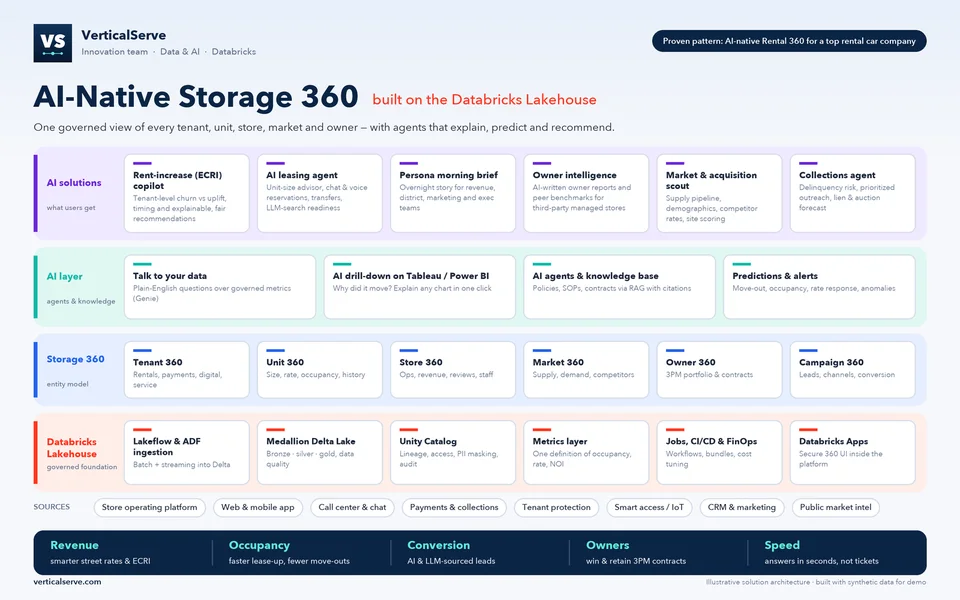
Storage 360 for self-storage
The same pattern for self-storage portfolios: units, stores, markets and tenants, with pricing a revenue manager can explain.
Self-storage
Storage 360
AI insights, entity 360s and explainable pricing for self-storage operators, on data that stays in your own Databricks lakehouse.
- Street rates with four rules a revenue manager can read
- Like-for-like competitive price index per store
- Rent-increase copilot and simulator
- Morning briefs that say which store to fix today
Storage 360 field guides
How each part works
- Street rates you can explain — occupancy moves, an aged-vacancy push, a competitor guard and a cap
- Knowing where you stand — a like-for-like price index per store
- Rent increases — the largest pricing lever, and the easiest to overdo
- From dashboards to decisions — explained AI insights for a portfolio
- Building Storage 360 on the lakehouse — read-only data contracts and a nightly AI layer
Architecture
One data model, from sources to decisions
How both 360s are built: governed data in your lakehouse, one model on top, and an AI layer that explains itself.
Use cases
Where the 360 earns its keep
The decisions our rental and storage customers make from it most often.
Fleet rebalancing
Spot idle units and shortages by location and class, and weigh the transfer cost against the demand forecast.
Explainable pricing
Rate and street-rate recommendations with the rule or signal behind each move, and a record of every override.
Booking pace & demand
Pace against last year by market, no-show risk on upcoming pickups, and demand forecasts per class or unit type.
Churn & loyalty
Customer value and churn risk for retail and corporate accounts, with the engagement signals behind them.
Claims, tolls & fines recovery
Damage, toll and fine cases followed from incident to recovery, with exposure visible by location and brand.
Rent-increase planning
For self-storage: which tenants to increase, by how much, and what the simulator expects in move-outs.
Morning brief
A daily AI summary per role: what changed overnight, what needs attention, and where to click next.
Ask the data
Plain-language questions answered from the same governed model, so the assistant and the dashboard always agree.
Built on the platforms you already run
DatabricksConfluentRedpandaGoogle CloudAWSAzure
Reading
Reading
Field guides and architecture notes on rental and storage data.