This page has moved to the GenAI POD.
AI POD: copilots, knowledge bases and agents in production
A principal-led squad of 4–6 that ships a production copilot, RAG system or agent platform on your data, inside your environment — with evaluation, guardrails and governance built in. A typical AI POD runs 12 weeks.
What the AI POD delivers
One outcome, agreed in discovery, taken from a blank page to production. Most AI PODs combine two or three of the builds below with the LLMOps layer that makes them safe to run.
Enterprise copilots
Assistants for a defined job — answering from your documents and systems, drafting, summarizing and comparing — behind your SSO and role-based access, with every answer cited to its source.
RAG & knowledge bases
Ingestion from the places knowledge actually lives — email, SharePoint, tickets, wikis, code and databases — with source permissions respected on every result and sync that keeps answers tracking the source.
Agent platforms & workflows
Agents with skills and tools that run from chat, schedules or events on a governed harness. They read, check and draft; people decide inside their authority, and every action is logged.
Evaluation harness
Built in the foundation phase, before the first version of the system, so there is something to measure against. It runs on every change, and a regression blocks the release.
Guardrails
PII detection and redaction, prompt-injection checks on retrieved text and tool output, grounding checks on figures, and topic and toxicity policies — started in observe mode and switched on when you are ready.
Tracing & observability
Prompts, cost, latency and quality traced across model providers, so the team that inherits the system can see what it did, what it cost and why an answer came out the way it did.
Prompt management
Prompts treated as versioned, tested assets in a registry rather than strings scattered through code, with a review step before a prompt reaches production.
Agent governance
A register of every agent with an owner, model allow-lists, spend limits and release gates on each call, and the evidence kept for AI governance reviews.
Domain model tuning
Where a general model is not enough: curate the data, fine-tune a domain-specific small or large language model, evaluate it against the same harness, and deploy it.
How a 12-week AI POD runs
The same four-phase rhythm as every Innovation POD: weekly demos against the outcome metric, a steering review every two weeks, and no status decks.
Discovery
Week 1. We agree the outcome, the success metric, the data and systems in scope, and the POD composition. You get a fixed proposal.
Foundation
Weeks 2–4. Environment, IAM and the production read path to your data; the evaluation harness; and a thin end-to-end system in dev with its first evaluation report.
Build & iterate
Weeks 5–10. Weekly demos of working software. Guardrails, tracing and audit trails go in from the start of the build, and the last sprints are spent hardening, not adding features.
Production & handover
Weeks 11–12. Go-live with a first cohort of users, runbooks, the evaluation suite wired into your CI, and knowledge transfer. An optional run-the-system tier follows.
The products an AI POD builds on
We do not start from an empty repository. An AI POD stands up the parts of our InsightLake platform your outcome needs, in your cloud and behind your IAM, and spends its weeks on your use case instead of plumbing. The full list is in the product catalog.
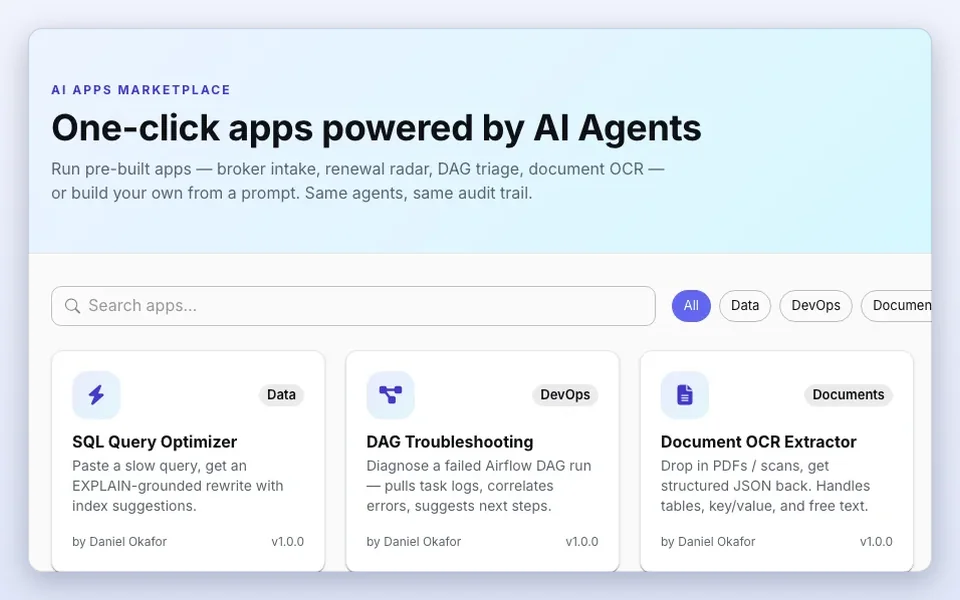
InsightStudio + InsightWorker
A hub where teams build, share and run AI apps, on InsightWorker, the agentic harness underneath: skills and tools run from chat, schedules, events, CLI or VS Code.
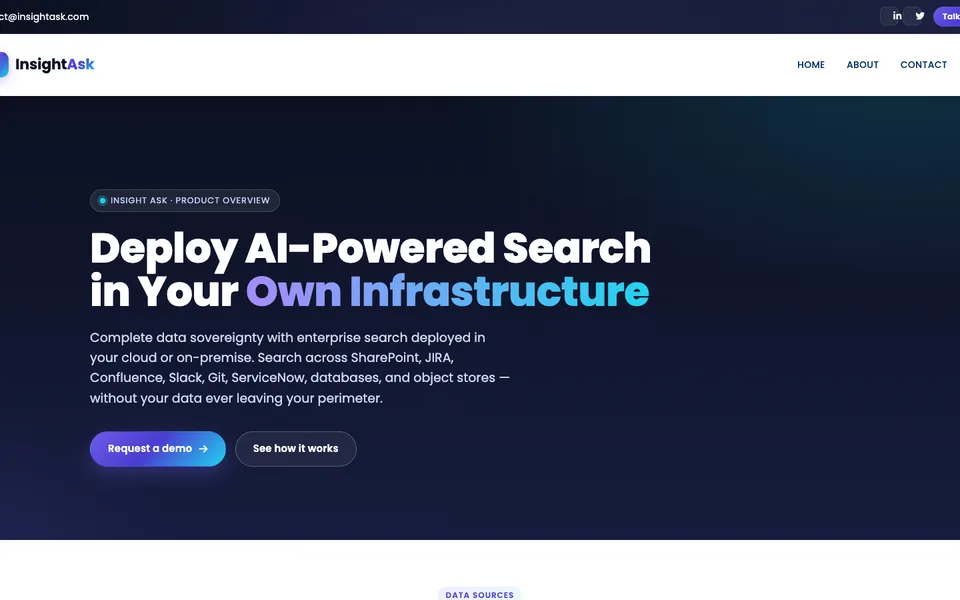
InsightAsk
One governed knowledge base across email, SharePoint, tickets, wikis, code and databases, hosted in your own infrastructure. Answers cite the documents they came from.
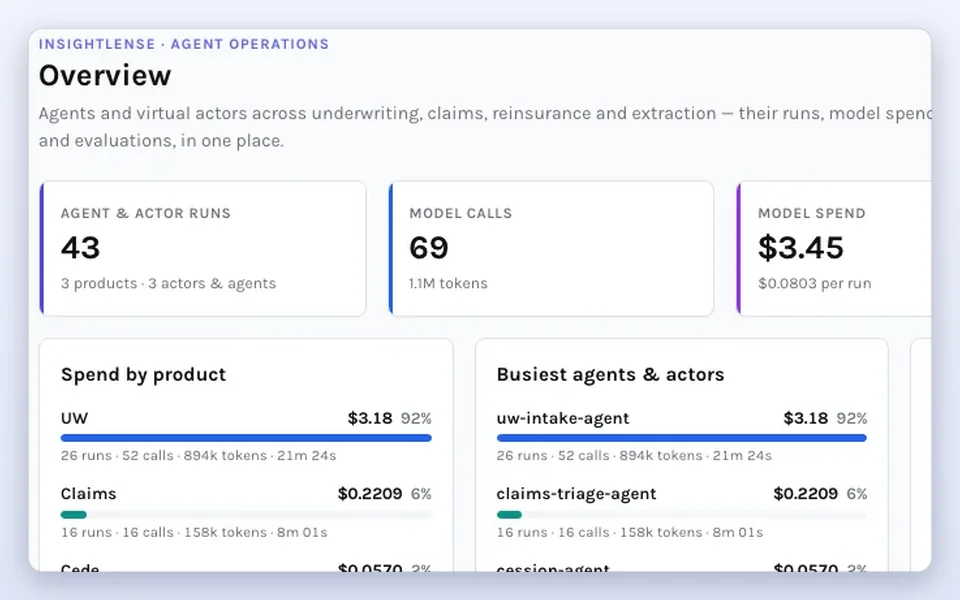
InsightLense
End-to-end LLM tracing and observability: prompts, costs, latency and quality traced across providers. Guardrail decisions are traced here too.

InsightResolve
Agentic L1 support and incident resolution: the alert fires, the runbook runs, and the incident closes or escalates with the root cause written down.
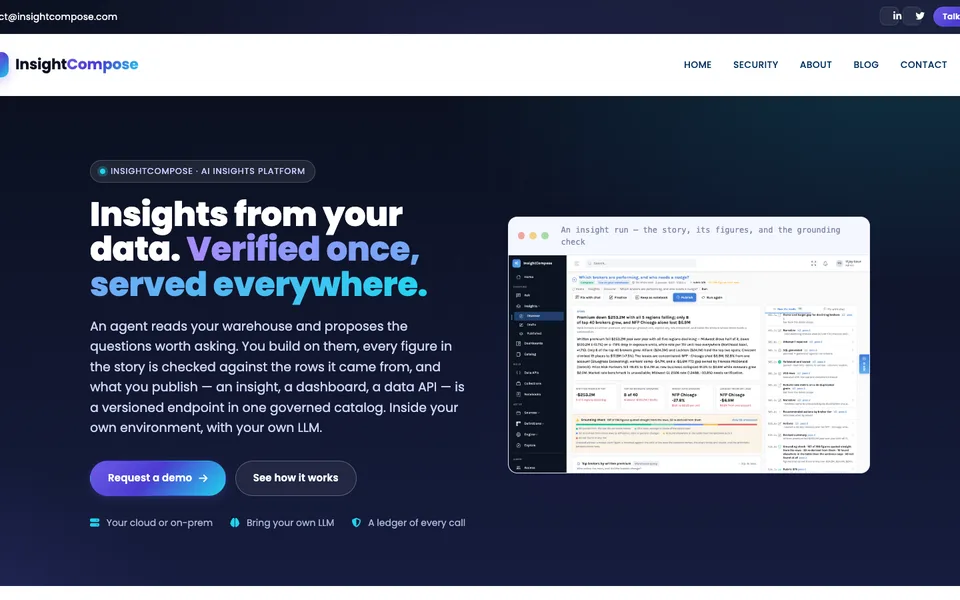
InsightCompose
Discover insights in your warehouse, verify them once and serve them everywhere: answers, dashboards and governed, versioned data APIs for apps and agents.
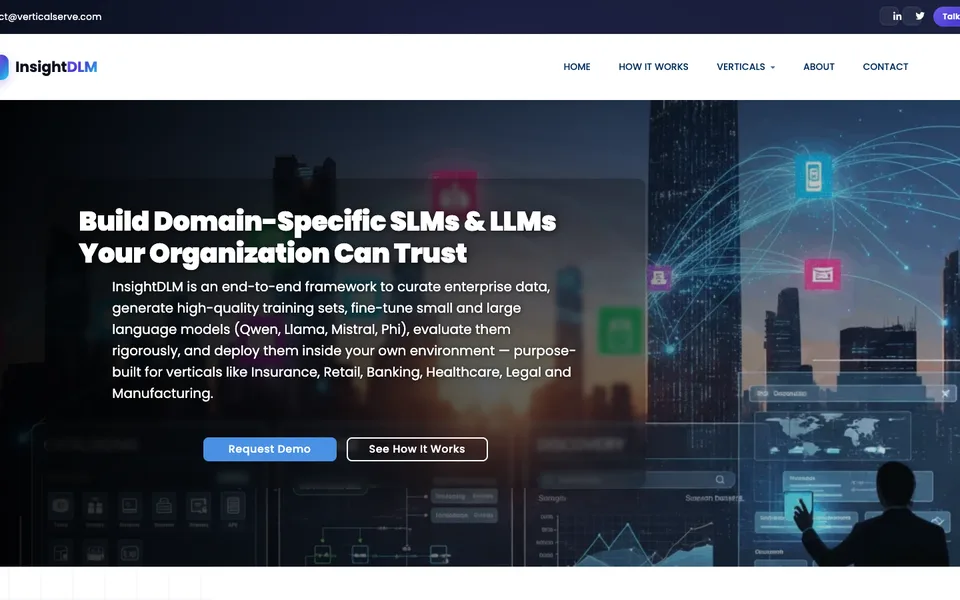
InsightDLM
An end-to-end framework for building domain-specific small and large language models: curate, fine-tune, evaluate, deploy.
InsightPrompts
Enterprise AI prompt management with governance, testing, and a certified prompt registry.
InsightControl
Governance for AI agents: discovers and inventories agents across platforms, flags agents with no owner or an unapproved model, enforces policies and spend limits on every call, and keeps the evidence for AI governance reviews.
Insight RAG
Build simple and advanced RAG systems with metadata management, guardrails, and SQL engines.
Guardrails, evaluation and governance, in the platform
Shared packages that every product can use, all built today. The guard only observes and the Govern gateway allows every call until you switch them on. Evaluations run when you ask for one.
4–6 senior practitioners, principal-led
The exact composition is named in the discovery proposal and can change sprint by sprint. Your engineers co-build from the first week, so the system has owners on your side when the POD leaves.
Principal engineer or architect
Leads the POD and owns the architecture and the outcome metric. Every POD lead has 10+ years in AI, data or cloud.
AI & agent engineers
Retrieval, prompts, agent skills and tools, evaluation, guardrails and tracing — the system itself and the LLMOps around it.
Data & platform engineers
The production read path to your data, ingestion and sync, environment, IAM, CI/CD and deployment in your cloud.
Product & domain lead
Keeps scope tied to the outcome, runs the weekly demo and the steering review, and works with your business sponsor and users.
Three ways to buy an AI POD
Every engagement starts with a one-week discovery that ends in a fixed proposal. After that, pick the commercial model that fits your stage.
Fixed-Outcome POD
One price for the outcome and the 12-week sprint.
- Fixed scope & deliverables
- Outcome metric agreed up front
- Weekly demos, fortnightly steerco
- Change-control budget included
- Production handover at week 12
POD on Time & Material
Pay for the team week by week as scope evolves.
- Senior, principal-led squad
- Compose roles per sprint
- Extend across multiple use cases
- Pause or scale with quarterly review
- Optional run-the-system tier
Innovation Credits
A pre-purchased pool of POD capacity drawn down across the year.
- Run multiple PODs in parallel
- Burndown across portfolio
- Quarterly innovation review
- Priority access to senior talent
- Roll over unused credits (one quarter)
AI engagements we have delivered
Three AI/ML engagements from the case-study library: governing models in production, and reading documents for completeness and compliance.
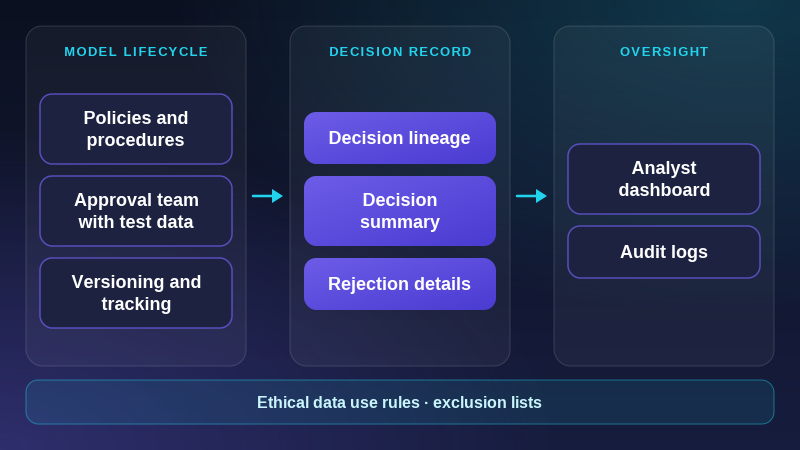
Ethical AI/ML Governance & Compliance Platform for a Leading Financial Firm
AI/ML, Governance, Finance
Automation of Corporate Investment contract document completeness and compliance checks
AI/ML, Finance, Automation
Automation of compliance checks on asset and wealth management documents
AI/ML, Finance, Compliance
Agents, knowledge bases and governance: field guides
Reference architectures and patterns from the teams who build them. Start with the AI Innovation POD playbook.
Common questions about the AI POD
Which models does the POD use?
Yours. The platform is bring-your-own-model, so the POD works with the model providers your organization has already approved, in your cloud account.
Where does our data go?
Nowhere. The POD works inside your environment — your cloud accounts, your IAM, your data. Our accelerators are deployed behind your boundary.
How do we know the system is good enough to ship?
The evaluation harness is built before the system is, against the outcome metric agreed in discovery. It runs on every change and is handed over wired into your CI, with documented thresholds.
Do we have to adopt your products?
No. They are accelerators, used where they shorten the path to your outcome. All custom code is yours; InsightLake products ship under their own licenses, optionally deployed in your environment.
What do we need before starting?
An outcome you can name and a production environment to deploy into. If the scope is still “explore AI for a team”, start with the one-week discovery; it ends with a fixed proposal.
What happens after week 12?
Your team runs the system with the runbooks and evaluation suite. If you prefer, an optional run-the-system tier provides 24x7 on-call, SLOs and continuous improvement against your outcome metric.